Head to head
Celestron AstroMaster 70AZ vs Travel Scope 70 (2027)
Two 70mm Celestron refractors compared: the long-tube AstroMaster 70AZ against the backpack Travel Scope 70, on planets, travel and first-night ease.
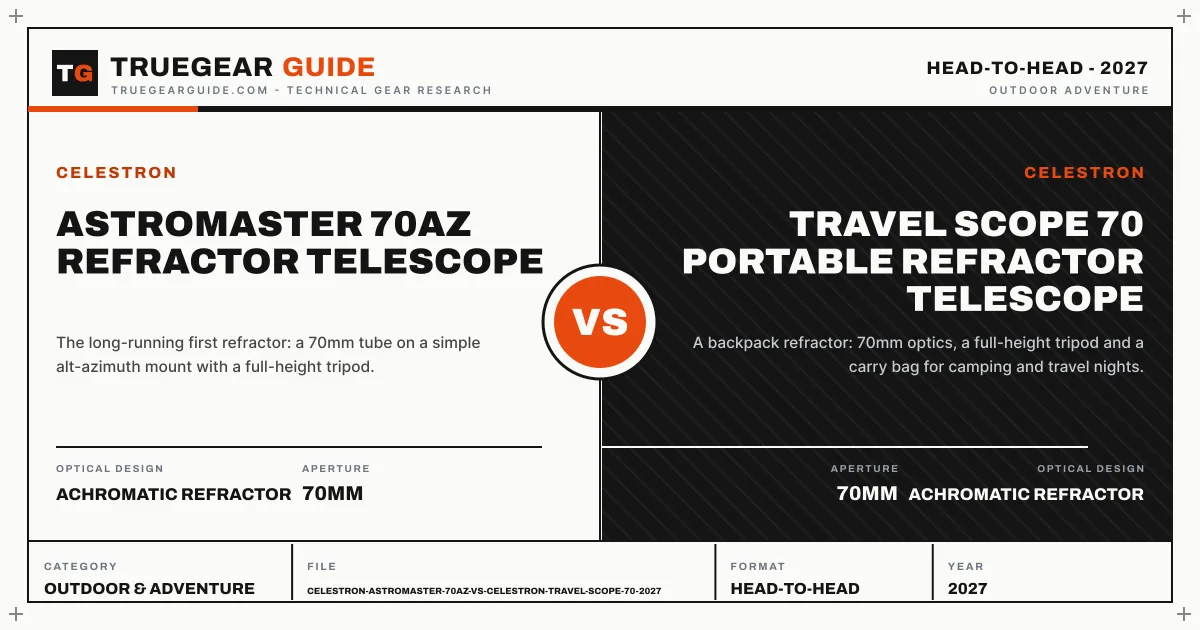

Celestron AstroMaster 70AZ Refractor Telescope
The long-running first refractor: a 70mm tube on a simple alt-azimuth mount with a full-height tripod.
- Optical design: Achromatic refractor
- Aperture: 70mm

Celestron Travel Scope 70 Portable Refractor Telescope
A backpack refractor: 70mm optics, a full-height tripod and a carry bag for camping and travel nights.
- Optical design: Achromatic refractor
- Aperture: 70mm
What owners report
Most praised
- First-time buyers get the Moon in the eyepiece on the first clear night without a long setup ritual
- Parents value a scope children can aim by pushing the tube rather than learning mount controls first
- The erect image diagonal turns the same kit into a usable daytime spotting scope for distant scenery
Common complaints
- Owners expecting galaxy detail from a 70mm tube are disappointed by how faint deep-sky targets look
- The tripod legs and mount head feel light for the long tube in a breeze
- High-power views demand patience, because small mount vibrations take a moment to settle
What owners report
Most praised
- Campers report the backpack is the reason the scope actually leaves the house, unlike heavier kits
- Children manage the pan-handle mount on their own after one guided evening
- Daytime users keep it by a window for birds and distant hills between night sessions
Common complaints
- Owners chasing crisp planet detail find the short tube runs out of useful magnification early
- The included tripod flexes in wind, and buyers often plan a sturdier tripod as the first upgrade
- The finderscope needs careful alignment, or beginners sweep past the Moon more than once
Our recommendation
Choose by where the scope will live, not by aperture, because both are 70mm. The AstroMaster 70AZ is the home scope: its 900mm tube gives 45x and 90x views that show planets better, on a full-height tripod for standing observers. The Travel Scope 70 is the travelling scope: its 400mm tube packs into a backpack and sets up in seconds, but tops out at 20x and 40x with the included eyepieces. If the scope mostly stays at home, buy the AstroMaster. If it must travel, buy the Travel Scope and accept smaller planet images.
Focal length and planet views
The AstroMaster tube is 900mm long, giving 45x and 90x from its eyepieces. The Travel Scope tube is 400mm long, giving 20x and 40x. That gap decides planet viewing: Jupiter and Saturn look larger and more detailed through the AstroMaster, while the Travel Scope shows them small but bright and easy to find. For Moon viewing, both delight, but the AstroMaster frames craters more closely.
Size, storage and travel
The Travel Scope wins outright here. Its kit packs into a backpack, its tripod collapses for travel, and setup needs no tools. The AstroMaster needs a corner or a cupboard for its long tube, and its full-height tripod is a home fixture rather than a travel companion. A scope that must fly, camp or fit a small flat points to the Travel Scope.
Mounts and aiming
Both use manual alt-azimuth mounts, but they feel different. The AstroMaster mount suits a standing adult at a fixed observing spot, with an adjustable-height tripod. The Travel Scope mount uses a pan handle and a lighter travel tripod, which suits quick sessions and children, but shakes more at high power and in wind. Neither mount tracks; both need small nudges as targets drift.
Daytime use
Both include an erect image diagonal for correct-orientation daytime views, so both double as spotting scopes. The Travel Scope earns more daytime use simply because it travels: it goes to viewpoints, campsites and birdwatching spots where the AstroMaster stays home. The AstroMaster gives a larger daytime image, but only where it already lives.
Choose Celestron AstroMaster 70AZ Refractor Telescope if…
- The scope will mostly stay at home or in the garden
- Planets and closer Moon views matter more than packability
- A standing-height tripod for adult observers is preferred
- You want the strongest 70mm planet views in this guide at a beginner price
Choose Celestron Travel Scope 70 Portable Refractor Telescope if…
- The scope must pack into a backpack for travel or camping
- Setup in seconds matters more than maximum magnification
- Children will carry and use the scope themselves
- Wide-field Moon and cluster views suit your observing style
Questions, answered
Which 70mm scope shows Saturn better?
The AstroMaster 70AZ, because its 900mm focal length gives 90x with the included 10mm eyepiece, against 40x from the Travel Scope 70. Saturn rings are visible through both, but they appear larger and more detailed through the AstroMaster.
Can either scope be used for daytime viewing?
Yes, both include an erect image diagonal that keeps daytime views the right way up. The Travel Scope is the more practical daytime companion, because it packs and travels, while the AstroMaster is the better fixed daytime scope at home.
Which is better for a child first telescope?
The Travel Scope 70, if the child will carry it and set it up. The AstroMaster 70AZ, if an adult will set it up at home and the child mainly observes through it. Both mounts are intuitive, so the deciding factor is who carries the kit.
Every guide on Telescopes15 pages
- Topic hubTelescopes
- Best ofThe Best Telescopes (2027)
- A beginner ranking should measure first-night success, not catalogue aperture. This guide weights finding help, mount simplicity and setup time ahead of raw optics, because a scope that finds the Moon and a planet on night one gets used again, while a scope that leaves a beginner sweeping empty sky gets stored. Manual classics stay in the list for learners who want the traditional route, but they are judged honestly against guided alternatives.The Best Telescopes for Beginners (2027)
- Planetary observing rewards focal length, steady air and a mount that holds a planet still at high power. Wide-field deep-sky scopes can show planets, but they are not optimised for the job. This ranking therefore favours longer focal lengths, slow-motion or GoTo tracking, and mounts that settle quickly, while keeping aperture honest: a steady 102mm scope often beats a shaky 130mm scope on a planet.The Best Telescopes for Planets (2027)
- Astrophotography beginners face a fork: photograph deep sky with a smart scope that does the work, or learn visual astronomy first and add a camera later. This guide is blunt about that fork. Smart scopes produce deep-sky images from night one but teach little about eyepiece observing. GoTo visual scopes can take Moon and planet photos, but long deep-sky exposures need equatorial mounts and guiding that none of the visual scopes here promise. The ranking follows what each scope actually delivers, not what a camera adapter implies.The Best Telescopes for Astrophotography Beginners (2027)
- ReviewCelestron AstroMaster 70AZ Review (2027)
- ReviewCelestron PowerSeeker 127EQ Review (2027)
- ReviewCelestron NexStar 130SLT Review (2027)
- ReviewCelestron NexStar 8SE Review (2027)
- ReviewCelestron Travel Scope 70 Review (2027)
- ReviewGskyer 80mm AZ (AZ80400) Review (2027)
- Head to headCelestron NexStar 130SLT vs NexStar 8SE (2027)
- Buying guideTelescope Buying Guide (2027)
- Fix itTelescope Cannot Find Anything? Fixes (2027)