A beginner ranking should measure first-night success, not catalogue aperture. This guide weights finding help, mount simplicity and setup time ahead of raw optics, because a scope that finds the Moon and a planet on night one gets used again, while a scope that leaves a beginner sweeping empty sky gets stored. Manual classics stay in the list for learners who want the traditional route, but they are judged honestly against guided alternatives.
The Best Telescopes for Beginners (2027)
Beginner telescopes for 2027, ranked on first-night success: simple mounts, phone guidance, GoTo help and scopes that actually get used.
The short answer
Buy the StarSense Explorer DX 102AZ if you want guidance without motors. Buy the AstroMaster 70AZ if the budget is tight and you are happy to learn star-hopping slowly. Buy the Heritage 130 if deep-sky value matters and you have a solid table. Buy the NexStar 130SLT if you want the computer to find targets for you from the start.
Our top picks at a glance
- Celestron StarSense Explorer DX 102AZ TelescopeThe DX step up: 102mm refractor optics with StarSense guidance and slow-motion controls for steadier tracking.Best beginner scope overall
- Celestron AstroMaster 70AZ Refractor TelescopeThe long-running first refractor: a 70mm tube on a simple alt-azimuth mount with a full-height tripod.Best first scope on a budget
- Celestron StarSense Explorer LT 80AZ TelescopeA phone-guided 80mm refractor: dock a smartphone, follow on-screen arrows, and stop hunting blind.Best guided scope under a mid price
- Celestron NexStar 130SLT Computerized TelescopeA compact GoTo Newtonian: 130mm of aperture with a hand control that finds and tracks thousands of objects.Best GoTo beginner scope
- Sky-Watcher Heritage 130 Tabletop Dobsonian TelescopeMaximum aperture for the money: a collapsible 130mm Dobsonian that sits on a sturdy table and just works.Best beginner scope for deep sky
- Celestron Travel Scope 70 Portable Refractor TelescopeA backpack refractor: 70mm optics, a full-height tripod and a carry bag for camping and travel nights.Best beginner scope for families on the move
- Gskyer 80mm AZ Space Astronomical Refractor Telescope (AZ80400)A low-cost complete kit: 80mm refractor, three eyepieces, Barlow, phone adapter and stainless tripod.Best complete beginner kit
The picks, ranked
Every product in this lineup was picked for this use case, ranked with our strongest choices first. If a product from the wider category does not genuinely fit this scenario, it is not listed here.
| # | Product | Award | Optical design | Aperture | Focal length | Eyepieces | Mount |
|---|---|---|---|---|---|---|---|
| 1 | Celestron StarSense Explorer DX 102AZ Telescope | Best beginner scope overall | Achromatic refractor | 102mm | 660mm, f/6.5 | 25mm (26x) and 10mm (66x) | Manual alt-azimuth, dual-axis slow-motion controls |
| 2 | Celestron AstroMaster 70AZ Refractor Telescope | Best first scope on a budget | Achromatic refractor | 70mm | 900mm, f/12.9 | 20mm (45x) and 10mm (90x) | Manual alt-azimuth, adjustable-height tripod |
| 3 | Celestron StarSense Explorer LT 80AZ Telescope | Best guided scope under a mid price | Achromatic refractor | 80mm | 900mm, f/11 | 25mm (36x) and 10mm (90x), plus 2x Barlow | Manual alt-azimuth, preassembled tripod |
| 4 | Celestron NexStar 130SLT Computerized Telescope | Best GoTo beginner scope | Newtonian reflector | 130mm | 650mm, f/5 | 20mm and 9mm | Computerized alt-azimuth, single fork arm |
| 5 | Sky-Watcher Heritage 130 Tabletop Dobsonian Telescope | Best beginner scope for deep sky | Newtonian reflector, Dobsonian | 130mm | 650mm, f/5 | 25mm and 10mm, 1.25 in | Tabletop Dobsonian rocker box |
| 6 | Celestron Travel Scope 70 Portable Refractor Telescope | Best beginner scope for families on the move | Achromatic refractor | 70mm | 400mm, f/5.71 | 20mm (20x) and 10mm (40x) | Manual alt-azimuth, pan handle, full-height tripod |
| 7 | Gskyer 80mm AZ Space Astronomical Refractor Telescope (AZ80400) | Best complete beginner kit | Achromatic refractor | 80mm | 400mm, f/5 | 25mm (16x), 10mm (40x), 5mm (80x), plus 3x Barlow | Manual alt-azimuth, stainless steel tripod |
Best beginner scope overall
Celestron StarSense Explorer DX 102AZ Telescope
The DX step up: 102mm refractor optics with StarSense guidance and slow-motion controls for steadier tracking.

Strengths
- StarSense guidance on a manual mount gives GoTo-like finding without motors or mount batteries
- Dual-axis slow-motion controls let observers track smoothly, a clear upgrade over the LT mount
- 102mm aperture at 660mm focal length gives 26x from the 25mm eyepiece and 66x from the 10mm eyepiece
- Erect image diagonal keeps daytime viewing correctly oriented, so the scope earns its keep by day
Limitations
- The DX price buys guidance and mount refinement, not a jump in aperture over cheaper 102mm scopes
- Phone dock alignment must be done carefully, or the app arrows point slightly off target
- Refractor colour fringing remains on the brightest lunar and planetary edges
What owners report
Most praised
- The slow-motion knobs are the upgrade owners mention most, after guidance itself
- Planetary viewers like the steady, contrasty refractor image at moderate power
- The app list of tonight best targets stops clear nights being wasted deciding what to look at
Common complaints
- Owners comparing prices note a manual 102mm scope without StarSense costs less for the same optics
- Dock calibration takes a few tries on the first night, especially in light-polluted skies
- The mount still needs a firm tripod setup, or slow-motion tracking feels uneven
| Optical design | Achromatic refractor |
|---|---|
| Aperture | 102mm |
| Focal length | 660mm, f/6.5 |
| Eyepieces | 25mm (26x) and 10mm (66x) |
| Mount | Manual alt-azimuth, dual-axis slow-motion controls |
| Guidance | StarSense Explorer app, smartphone dock |
Best for: Beginners who want phone guidance plus a sturdier mount, and observers who like refractors for planets.
Skip if: Deep-sky aperture is the priority; a 102mm refractor costs more per millimetre than a Dobsonian reflector.
Best first scope on a budget
Celestron AstroMaster 70AZ Refractor Telescope
The long-running first refractor: a 70mm tube on a simple alt-azimuth mount with a full-height tripod.

Strengths
- 70mm fully coated achromatic objective with a long 900mm focal length, a forgiving combination for lunar and planetary detail
- Alt-azimuth mount moves the way a camera tripod does, so first-night aiming needs no polar alignment lesson
- Two eyepieces, 20mm for 45x and 10mm for 90x, plus an erect image diagonal for correct-orientation daytime views
- StarPointer red dot finder and an adjustable-height tripod keep the whole kit usable standing up
Limitations
- At f/12.9 the tube is long for its aperture, so storage and transport need more room than a short-tube scope
- An achromatic refractor at this price shows some colour fringing on the brightest Moon and planet edges
- The mount is a starter mount: it steadies low-power views well and shudders more as magnification climbs
What owners report
Most praised
- First-time buyers get the Moon in the eyepiece on the first clear night without a long setup ritual
- Parents value a scope children can aim by pushing the tube rather than learning mount controls first
- The erect image diagonal turns the same kit into a usable daytime spotting scope for distant scenery
Common complaints
- Owners expecting galaxy detail from a 70mm tube are disappointed by how faint deep-sky targets look
- The tripod legs and mount head feel light for the long tube in a breeze
- High-power views demand patience, because small mount vibrations take a moment to settle
| Optical design | Achromatic refractor |
|---|---|
| Aperture | 70mm |
| Focal length | 900mm, f/12.9 |
| Eyepieces | 20mm (45x) and 10mm (90x) |
| Mount | Manual alt-azimuth, adjustable-height tripod |
| Finder | StarPointer red dot finder |
Best for: Absolute beginners and families who want a first scope for the Moon, bright planets and daytime viewing.
Skip if: Faint galaxies and nebulae are the main goal; 70mm shows them only as dim smudges under most skies.
Best guided scope under a mid price
Celestron StarSense Explorer LT 80AZ Telescope
A phone-guided 80mm refractor: dock a smartphone, follow on-screen arrows, and stop hunting blind.

Strengths
- StarSense sky recognition uses the docked phone camera to work out where the telescope points, in real time
- The app gives directional arrows to the chosen target, which removes most first-night finding frustration
- 80mm refractor with 900mm focal length gives 36x from the 25mm eyepiece and 90x from the 10mm eyepiece
- A 2x Barlow, erect image diagonal and preassembled mount and tripod keep the kit complete and simple
Limitations
- Guidance depends on the phone: a flat battery, an incompatible handset or a cloudy app view stops the help
- The mount itself is manual, so the app points but the observer still pushes and tracks by hand
- Long f/11 tube needs storage space, and the phone dock adds a step to every setup
What owners report
Most praised
- New observers find their first nebula in minutes, where a manual finder alone had left them circling
- The app tour list gives families a ready-made observing plan for each clear night
- The preassembled mount means setup is mostly unfolding legs and docking the phone
Common complaints
- Phone compatibility checks catch some buyers after purchase, when their handset is not supported
- Night phone glare annoys dark-adapted observers, even with the screen dimmed
- Manual tracking at high power still needs practice, since the app does not move the tube
| Optical design | Achromatic refractor |
|---|---|
| Aperture | 80mm |
| Focal length | 900mm, f/11 |
| Eyepieces | 25mm (36x) and 10mm (90x), plus 2x Barlow |
| Mount | Manual alt-azimuth, preassembled tripod |
| Guidance | StarSense Explorer app, smartphone dock |
Best for: Beginners who get lost star-hopping and want app guidance without motors, batteries or a GoTo mount.
Skip if: You do not want a phone at the telescope, or your phone is not compatible with the StarSense app.
Best GoTo beginner scope
Celestron NexStar 130SLT Computerized Telescope
A compact GoTo Newtonian: 130mm of aperture with a hand control that finds and tracks thousands of objects.

Strengths
- Computerized alt-azimuth mount slews to objects from a database of more than 4,000 stars, galaxies and nebulae
- SkyAlign alignment needs any three bright objects centred in the eyepiece, not named stars from a chart
- 130mm Newtonian tube at 650mm focal length stays compact for transport and sets up in minutes
- NexStar+ hand control tracks targets once found, so planets stay in view while observers swap eyepieces
Limitations
- It runs on 8 AA batteries or 12V DC, neither included, so a first night needs a power plan
- A single fork arm alt-azimuth mount is convenient, not a long-exposure astrophotography platform
- GoTo accuracy depends on careful alignment and a level tripod, and sloppy setup shows up as missed targets
What owners report
Most praised
- The hand control turns a first dark-site night into a tour, with one target after another landing in view
- The short tube packs into a car far more easily than the long refractors beginners often start with
- SkyAlign feels forgiving, because it accepts bright objects the observer can already recognise
Common complaints
- Battery appetite surprises buyers who assumed a mains or rechargeable pack came in the box
- Alignment fails frustrate first users until they learn to level the tripod and centre stars carefully
- The mount can sound and feel busy while slewing, which puts off observers used to silent manual scopes
| Optical design | Newtonian reflector |
|---|---|
| Aperture | 130mm |
| Focal length | 650mm, f/5 |
| Eyepieces | 20mm and 9mm |
| Mount | Computerized alt-azimuth, single fork arm |
| Database | More than 4,000 objects, SkyAlign |
Best for: Beginners who want the computer to do the finding, and observers who travel to dark sites with a short tube.
Skip if: You dislike batteries and menus; this scope needs power and a three-star alignment before it earns its keep.
Best beginner scope for deep sky
Sky-Watcher Heritage 130 Tabletop Dobsonian Telescope
Maximum aperture for the money: a collapsible 130mm Dobsonian that sits on a sturdy table and just works.

Strengths
- 130mm parabolic mirror on a simple Dobsonian base gives bright deep-sky views at a beginner price
- FlexTube collapsible design shortens the tube for storage and transport between sessions
- Push-to-point Dobsonian motion is intuitive: push the tube, release, and it stays where aimed
- Two eyepieces, 25mm and 10mm, plus a StarPointer finder cover low-power finding and closer views
Limitations
- A tabletop scope is only as good as its table: a wobbly surface ruins the stability advantage
- No tracking, no slow-motion controls and no guidance, so planets drift and finding is manual
- The open truss-style tube needs care against dust and stray light compared with a closed tube
What owners report
Most praised
- Value hunters call it the cheapest honest route to 130mm deep-sky views
- The collapsible tube makes the scope easy to carry to a dark site in a small car
- Push-to aiming feels natural to complete beginners, with no mount controls to learn
Common complaints
- Owners without a suitable table end up buying or building a stand before the scope feels right
- Manual tracking at high power means frequent nudges, which tires planetary observers
- The truss shroud question comes up often, since stray light reaches the mirror more easily
| Optical design | Newtonian reflector, Dobsonian |
|---|---|
| Aperture | 130mm |
| Focal length | 650mm, f/5 |
| Eyepieces | 25mm and 10mm, 1.25 in |
| Mount | Tabletop Dobsonian rocker box |
| Coatings | Radiant Aluminum Quartz |
Best for: Beginners who want the most deep-sky reach per pound spent, and observers with a solid garden table.
Skip if: You have no suitable table or need a standing-height tripod scope; this one needs a stable surface.
Best beginner scope for families on the move
Celestron Travel Scope 70 Portable Refractor Telescope
A backpack refractor: 70mm optics, a full-height tripod and a carry bag for camping and travel nights.

Strengths
- The whole kit, tube, tripod and eyepieces, packs into the included custom backpack
- Tool-free assembly gets the scope from bag to observing in seconds, which matters on short trips
- Fully coated 70mm optics with 20mm and 10mm eyepieces give 20x and 40x views for Moon and scenery
- A 45 degree erect image diagonal keeps daytime views the right way up for wildlife and landscapes
Limitations
- Short focal length and modest aperture cap planetary detail well below longer 70mm refractors
- The travel tripod prioritises pack size over rigidity, so high-power views shake more
- A 400mm tube needs low-power patience: it is a wide-field scope, not a high-magnification planet scope
What owners report
Most praised
- Campers report the backpack is the reason the scope actually leaves the house, unlike heavier kits
- Children manage the pan-handle mount on their own after one guided evening
- Daytime users keep it by a window for birds and distant hills between night sessions
Common complaints
- Owners chasing crisp planet detail find the short tube runs out of useful magnification early
- The included tripod flexes in wind, and buyers often plan a sturdier tripod as the first upgrade
- The finderscope needs careful alignment, or beginners sweep past the Moon more than once
| Optical design | Achromatic refractor |
|---|---|
| Aperture | 70mm |
| Focal length | 400mm, f/5.71 |
| Eyepieces | 20mm (20x) and 10mm (40x) |
| Mount | Manual alt-azimuth, pan handle, full-height tripod |
| Kit | Backpack, erect image diagonal, 5x24 finderscope |
Best for: Travellers, campers and families who need a scope that packs away and sets up in seconds.
Skip if: Deep-sky observing is the priority; a short 400mm tube trades reach for packability.
Best complete beginner kit
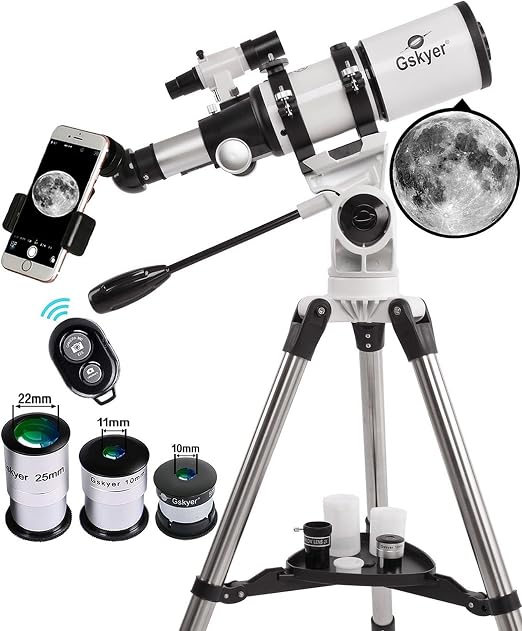
Gskyer 80mm AZ Space Astronomical Refractor Telescope (AZ80400)
A low-cost complete kit: 80mm refractor, three eyepieces, Barlow, phone adapter and stainless tripod.
Strengths
- 80mm aperture with a short 400mm focal length gives bright, wide low-power views of the Moon and clusters
- Three eyepieces, 25mm, 10mm and 5mm, give 16x, 40x and 80x before the included 3x Barlow is added
- A 6x30 finderscope is larger than the small finders on many budget kits, which helps first aiming
- Phone adapter and wireless remote in the box let beginners try Moon photos without extra purchases
Limitations
- The quoted top magnifications with the Barlow exceed what a short achromatic tube shows cleanly
- Documentation is thinner than Celestron manuals, so beginners may need online setup help
- Focuser and eyepiece quality are entry level, and a future eyepiece upgrade improves the scope most
What owners report
Most praised
- Buyers on a tight budget value opening one box and having eyepieces, Barlow and phone holder ready
- The wide low-power view makes finding the Moon and bright clusters less stressful for new users
- Gift buyers report the kit works as a complete present, with no immediate accessory hunt
Common complaints
- Owners who push the Barlow to its advertised extremes get soft, dim images and blame the tube
- Assembly instructions leave first-timers guessing about diagonal and finder orientation
- The mount needs gentle handling at high power, where vibrations linger
| Optical design | Achromatic refractor |
|---|---|
| Aperture | 80mm |
| Focal length | 400mm, f/5 |
| Eyepieces | 25mm (16x), 10mm (40x), 5mm (80x), plus 3x Barlow |
| Mount | Manual alt-azimuth, stainless steel tripod |
| Finder | 6x30 finderscope |
Best for: Budget buyers and families who want the full accessory set in one box, including phone photography.
Skip if: Optical refinement matters more than kit completeness; this is a starter refractor, not a premium optic.
Questions, answered
Should a beginner buy a manual or GoTo telescope?
Manual scopes teach the sky and cost less, but finding faint targets takes practice. GoTo scopes find targets for you and cost more, and need power and alignment. App-guided scopes sit between the two: manual mounts with phone arrows. Choose by patience, not prestige.
How much should a first telescope cost?
A usable first scope starts in the budget tier in this guide, with a complete kit and a steady-enough mount. Spending more mainly buys aperture, guidance or mount quality, not a different Moon. Avoid the cheapest toy scopes, which have poor mounts and plastic optics that put beginners off.
What can a beginner actually see on the first night?
The Moon in detail, Jupiter as a disk with moons, Saturn as a ringed oval, and bright clusters and nebulae as glowing patches. Galaxies appear faint and small through an eyepiece. A smart telescope photographs them brighter, but that is imaging, not eyepiece viewing.
Does a beginner need a dark sky site?
No, but it helps enormously. The Moon and planets show well from a garden, even in a town. Faint deep-sky targets improve dramatically under darker skies, which is why travel-friendly scopes earn their keep. Start at home, then take the scope to a darker site once the basics feel easy.
Every guide on Telescopes15 pages
- Topic hubTelescopes
- Best ofThe Best Telescopes (2027)
- Planetary observing rewards focal length, steady air and a mount that holds a planet still at high power. Wide-field deep-sky scopes can show planets, but they are not optimised for the job. This ranking therefore favours longer focal lengths, slow-motion or GoTo tracking, and mounts that settle quickly, while keeping aperture honest: a steady 102mm scope often beats a shaky 130mm scope on a planet.The Best Telescopes for Planets (2027)
- Astrophotography beginners face a fork: photograph deep sky with a smart scope that does the work, or learn visual astronomy first and add a camera later. This guide is blunt about that fork. Smart scopes produce deep-sky images from night one but teach little about eyepiece observing. GoTo visual scopes can take Moon and planet photos, but long deep-sky exposures need equatorial mounts and guiding that none of the visual scopes here promise. The ranking follows what each scope actually delivers, not what a camera adapter implies.The Best Telescopes for Astrophotography Beginners (2027)
- ReviewCelestron AstroMaster 70AZ Review (2027)
- ReviewCelestron PowerSeeker 127EQ Review (2027)
- ReviewCelestron NexStar 130SLT Review (2027)
- ReviewCelestron NexStar 8SE Review (2027)
- ReviewCelestron Travel Scope 70 Review (2027)
- ReviewGskyer 80mm AZ (AZ80400) Review (2027)
- Head to headCelestron AstroMaster 70AZ vs Travel Scope 70 (2027)
- Head to headCelestron NexStar 130SLT vs NexStar 8SE (2027)
- Buying guideTelescope Buying Guide (2027)
- Fix itTelescope Cannot Find Anything? Fixes (2027)