In-depth review
Celestron PowerSeeker 127EQ Review (2027)
The PowerSeeker 127EQ pairs 127mm of aperture with a manual equatorial mount. Our research-based verdict on its learning curve and value.
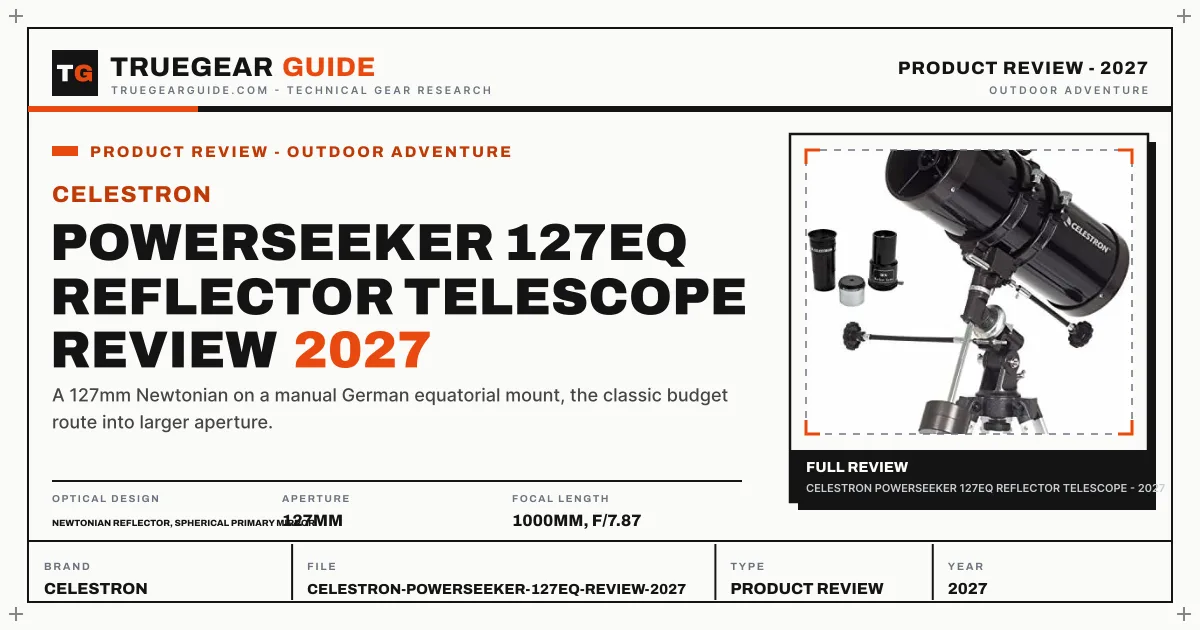

Celestron PowerSeeker 127EQ Reflector Telescope
A 127mm Newtonian on a manual German equatorial mount, the classic budget route into larger aperture.
Our verdict
The PowerSeeker 127EQ is a scope that rewards patience and punishes impatience in equal measure. Its 127mm aperture genuinely outclasses 70mm and 80mm starters on clusters and bright nebulae, and its equatorial mount teaches tracking properly. But the mount assembly, balancing and polar alignment are a real first-week project, and the spherical mirror and starter mount set a ceiling that keen observers will eventually meet. Buy it to learn equatorial astronomy on a budget, not as a shortcut to premium views.
What we like
- 127mm aperture gathers far more light than 70mm and 80mm starters, which shows in clusters and bright nebulae
- 1000mm focal length at f/7.87 gives useful planetary magnification from the included eyepieces
- German equatorial mount with slow-motion controls lets one axis track a target once roughly polar aligned
- The kit includes a 20mm eyepiece, a 4mm eyepiece and a 3x Barlow, so several magnifications arrive in the box
What to watch out for
- The spherical primary mirror is a cost-saving design, not the parabolic mirror found on dearer reflectors
- Equatorial setup is the learning curve: balance, latitude setting and polar alignment all come before observing
- The 4mm eyepiece pushes magnification to the edge of what most nights and this mount support
What owners report: Celestron PowerSeeker 127EQ Reflector Telescope
Synthesized from recurring themes in long-term owner feedback.
Most praised
- The jump from a small starter scope to this aperture makes familiar clusters look noticeably richer
- Slow-motion knobs let observers follow Jupiter across the field without constantly nudging the tube
- Families appreciate a kit that arrives with several magnifications instead of needing eyepieces at once
Common complaints
- New owners regularly assemble the equatorial mount wrong on the first attempt and need the manual twice
- The mount head and tripod are the weak link when the tube is pushed to high power
- Collimation checks catch beginners out, because the manual gives the topic less space than it deserves
Who it is for
Patient beginners and learners who want larger aperture and are willing to study mount setup before expecting easy nights.
The aperture jump is real
Moving from 70mm to 127mm more than triples the light-gathering area, and the difference shows on the first cluster night. Familiar open clusters resolve more stars, globular clusters start to show grain, and bright nebulae gain structure. The 1000mm focal length also gives planetary magnification without extreme eyepieces, although the mount, not the optics, decides how steady those views feel.
The equatorial mount is the course
A German equatorial mount looks intimidating because it is a different geometry: one axis points at the celestial pole, and tracking follows that axis. Once balanced and roughly polar aligned, slow-motion controls make following a planet genuinely smooth. Getting there takes reading the manual, setting latitude, balancing the tube and counterweight, and accepting that the first setup will be slow. Observers who enjoy that process learn skills that transfer to every equatorial mount.
The honest ceilings
Two ceilings matter. The spherical primary mirror is a budget design choice, so planetary detail will not match a parabolic mirror of the same size. And the starter equatorial mount and tripod, while adequate at low and medium power, show vibration at high power. The included 4mm eyepiece pushes magnification to the edge of both ceilings, so the most satisfying nights use the 20mm eyepiece and moderate power.
Key specifications
- Optical design
- Newtonian reflector, spherical primary mirror
- Aperture
- 127mm
- Focal length
- 1000mm, f/7.87
- Eyepieces
- 20mm (50x) and 4mm (250x), plus 3x Barlow
- Mount
- Manual German equatorial, slow-motion controls
- Finder
- 5x24 finderscope
Also consider

Sky-Watcher Heritage 130 Tabletop Dobsonian Telescope
Maximum aperture for the money: a collapsible 130mm Dobsonian that sits on a sturdy table and just works.
Why consider it: The simpler 130mm route, for observers who want similar aperture without equatorial setup or balancing
- Optical design: Newtonian reflector, Dobsonian
- Aperture: 130mm

Celestron StarSense Explorer DX 130AZ Telescope
StarSense guidance on a 130mm Newtonian: reflector aperture and phone pointing on a full-height tripod.
Why consider it: The guided 130mm route, for observers who want app help finding targets instead of equatorial alignment
- Optical design: Newtonian reflector
- Aperture: 130mm
Research-based assessment. TrueGear has not hands-on tested this product; this evaluation synthesizes manufacturer specifications, retailer documentation, and published expert reviews.
Questions, answered
Do I need to polar align the 127EQ every night?
Rough polar alignment each session is enough for visual observing. Point the mount axis roughly at Polaris, set your latitude, and the slow-motion controls will track well enough for eyepiece viewing. Precise alignment matters for photography, not for a first visual night.
Is the 127EQ good for planets?
Yes, at moderate power. The Moon, Jupiter and Saturn show well, and the equatorial tracking helps at higher magnification. Do not judge it by the 4mm eyepiece alone: that eyepiece pushes the scope and the sky to their limits on most nights.
How often does a Newtonian need collimation?
Check it after transport and whenever star images look soft or comet-shaped. Collimation aligns the mirrors, and a simple collimation cap or Cheshire tool makes the check routine. Beginners should expect to learn it, because every Newtonian owner eventually does.
Every guide on Telescopes15 pages
- Topic hubTelescopes
- Best ofThe Best Telescopes (2027)
- A beginner ranking should measure first-night success, not catalogue aperture. This guide weights finding help, mount simplicity and setup time ahead of raw optics, because a scope that finds the Moon and a planet on night one gets used again, while a scope that leaves a beginner sweeping empty sky gets stored. Manual classics stay in the list for learners who want the traditional route, but they are judged honestly against guided alternatives.The Best Telescopes for Beginners (2027)
- Planetary observing rewards focal length, steady air and a mount that holds a planet still at high power. Wide-field deep-sky scopes can show planets, but they are not optimised for the job. This ranking therefore favours longer focal lengths, slow-motion or GoTo tracking, and mounts that settle quickly, while keeping aperture honest: a steady 102mm scope often beats a shaky 130mm scope on a planet.The Best Telescopes for Planets (2027)
- Astrophotography beginners face a fork: photograph deep sky with a smart scope that does the work, or learn visual astronomy first and add a camera later. This guide is blunt about that fork. Smart scopes produce deep-sky images from night one but teach little about eyepiece observing. GoTo visual scopes can take Moon and planet photos, but long deep-sky exposures need equatorial mounts and guiding that none of the visual scopes here promise. The ranking follows what each scope actually delivers, not what a camera adapter implies.The Best Telescopes for Astrophotography Beginners (2027)
- ReviewCelestron AstroMaster 70AZ Review (2027)
- ReviewCelestron NexStar 130SLT Review (2027)
- ReviewCelestron NexStar 8SE Review (2027)
- ReviewCelestron Travel Scope 70 Review (2027)
- ReviewGskyer 80mm AZ (AZ80400) Review (2027)
- Head to headCelestron AstroMaster 70AZ vs Travel Scope 70 (2027)
- Head to headCelestron NexStar 130SLT vs NexStar 8SE (2027)
- Buying guideTelescope Buying Guide (2027)
- Fix itTelescope Cannot Find Anything? Fixes (2027)